As a successful entrepreneur, you have a wealth of expertise and insights to share in your book. But if your writing isn’t clear, readers will struggle to understand your message, and they’ll quit reading.
Here are five simple questions you can ask to assess clarity and keep readers engaged from start to finish:
Question 1: Does Each Paragraph Have One Clear Point?
You already know how all the pieces fit together, but your readers don’t—at least not yet. When you try to say too much at once, clarity breaks down.
Pick a random page in your manuscript and then a random paragraph. Can you identify the single main point of that paragraph in one sentence? If not, you’re probably trying to cover too much.
Signs of an unfocused paragraph:
- It covers multiple unrelated ideas.
- The first sentence and last sentence are about different things.
- You use transitional phrases like “Additionally,” “Also,” or “On the other hand” more than once.
How to fix it: Break it up; one point per paragraph. If you have three related ideas, write three paragraphs.
Question 2: Am I Telling AND Showing?
Abstract concepts are hard to grasp. Your readers need concrete examples to understand what you’re talking about.
Look at any section where you’re explaining a concept, strategy, or principle. Have you backed it up with a real example, case study, or scenario?
Weak: “Cross-functional teams are often more effective than siloed ones.”
Stronger: “Cross-functional teams are often more effective than siloed ones. As my company scaled, it began having frequent production bottlenecks. I got marketing, sales, and fulfillment to start meeting once a week to talk through exactly where projects were getting jammed up. With that one change, they started to catch bottlenecks in minutes instead of weeks, and projects finally started moving on schedule since each team knew exactly what the others needed.”
Use examples to paint a picture for readers, allowing them to better understand and remember your message.
Question 3: Have I Defined My Industry Jargon?
Every industry has its own language. Terms that feel basic to you might be completely foreign to your readers—even if they work in your field.
Go through your manuscript and circle every piece of jargon, technical term, or acronym. For each one, ask yourself: Would someone new to my industry know what this means?
If the answer is no, define it the first time you use it.
Some terms may require only a brief in-line definition for readers to recognize them: “Before you market to your ideal customer profile (ICP) …”
Others may require a full explanation to provide context before you use them: “Product-market fit is a measurement of how well a product satisfies market demand, i.e. fits the needs of your target customers.”
Make sure readers don’t need to decode your terminology before they can absorb your ideas.
Question 4: Can a Smart 8th Grader Understand This?
Clear writing is simple writing, regardless of your audience’s intelligence or expertise level.
Read through a few paragraphs of your book. Are you using unnecessarily complex words when simpler ones would work? Are your sentences long and winding, or are they direct and easy to follow?
Common red flags:
- Sentences longer than 25-30 words
- Passive voice (“The decision was made” vs. “We made the decision”)
- Fancy vocabulary that doesn’t add meaning (“utilize” instead of “use”)
Try this: Read your writing out loud. If you stumble over a sentence or lose track of what you’re saying halfway through, your readers will too. Simplify it.
Your expertise should come through in your insights and examples, not in your vocabulary or sentence structure.
Question 5: Would My Reader Know What To Do Next?
If you’re teaching readers how to do something, have you given them enough detail to actually do it? Or have you given them a vague overview that leaves them wondering about the specifics?
Vague: “To improve your team’s productivity, implement more efficient systems.”
Specific and actionable: “To improve your team’s productivity, start by identifying your three most time-consuming recurring tasks. For each one, ask: Can this be automated? Can we create a template? Can we delegate it to someone junior? Then implement one change per week.”
Walk through your advice as if you’re the reader. Are there gaps? Points where you’d think “Okay, but how?” If so, fill those gaps.
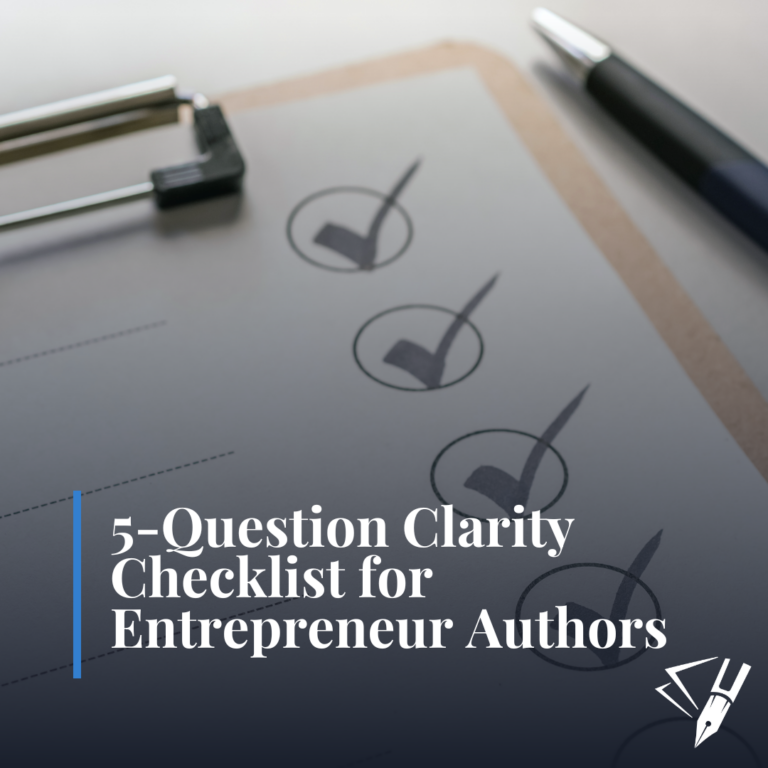
Before considering your draft “done,” assess it with this five-question clarity checklist. Clear writing makes your expertise accessible to readers, and in a world full of distractions, it keeps them engaged.
Need help clarifying your manuscript before publication? At Aha! Editorial, we specialize in helping busy entrepreneurs create clear and effective business books. Book a free call to discuss your project with us.

Owner of Aha! Editorial